Moving Average Convergence/Divergence Trading Method (MACD) The Moving Average Convergence Divergence Trading Method (MACD) is a momentum oscillator using two exponential moving averages. Although certain periods are suggested for the averages a trader can obviously experiment with different ones. The momentum line is usually constructed by subtracting a 26-day exponential moving average (period factor of 0.074) from a 12-day exponential moving average (period factor of 0.154). The difference is plotted around a zero line. A 9-day exponential moving average (period factor 0.2) is usually used to generate signals over the momentum line. Finally the difference between the 9-day moving average and the momentum line is taken and plotted as a histogram. Interpretation MACD can give buy and sell signals in many different ways. Because of the way it is constructed it essentially shows the momentum of the stock. Buy and sell signals can be generated just as with ROC when the momentum line crosses the zero line. The 9-day exponential moving average on the momentum line is used to generate signals in the same manner as a normal moving average. A crossing above the average is a buy signal; a crossing bellow is a sell signal. As with the Relative Strength Index (RSI) divergences in price action can be spotted, and trendlines can be used to give signals. An ideal buy signal would be spotting a bullish divergence, together with the 9-day average crossing the momentum line and followed by both lines crossing the zero line. The ideal sell signal would be the converse of this. One of the great strengths of MACD is that it smoothes price action without lagging behind. Because of the way it is calculated erratic price movements are filtered out. For example, if price jumps in a certain direction, both averages will jump in that same direction. When taking the difference the jump is far less extreme, and it won’t lag behind as with a normal moving average. This effect is strengthened when the period factors of both averages are very close. 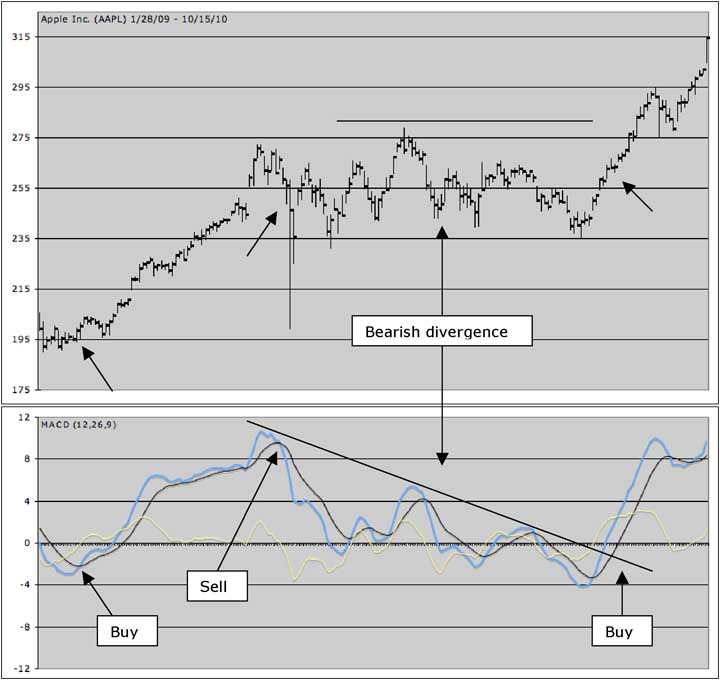 |
